Transcripts & history
Every call has a written transcript and a history you can review any time.
Every call your assistant handles is written down for you, word for word. So even if you were not there, you can always see exactly what the caller said and what your assistant did. This written version is called a transcript, and all your transcripts are kept in your call history.
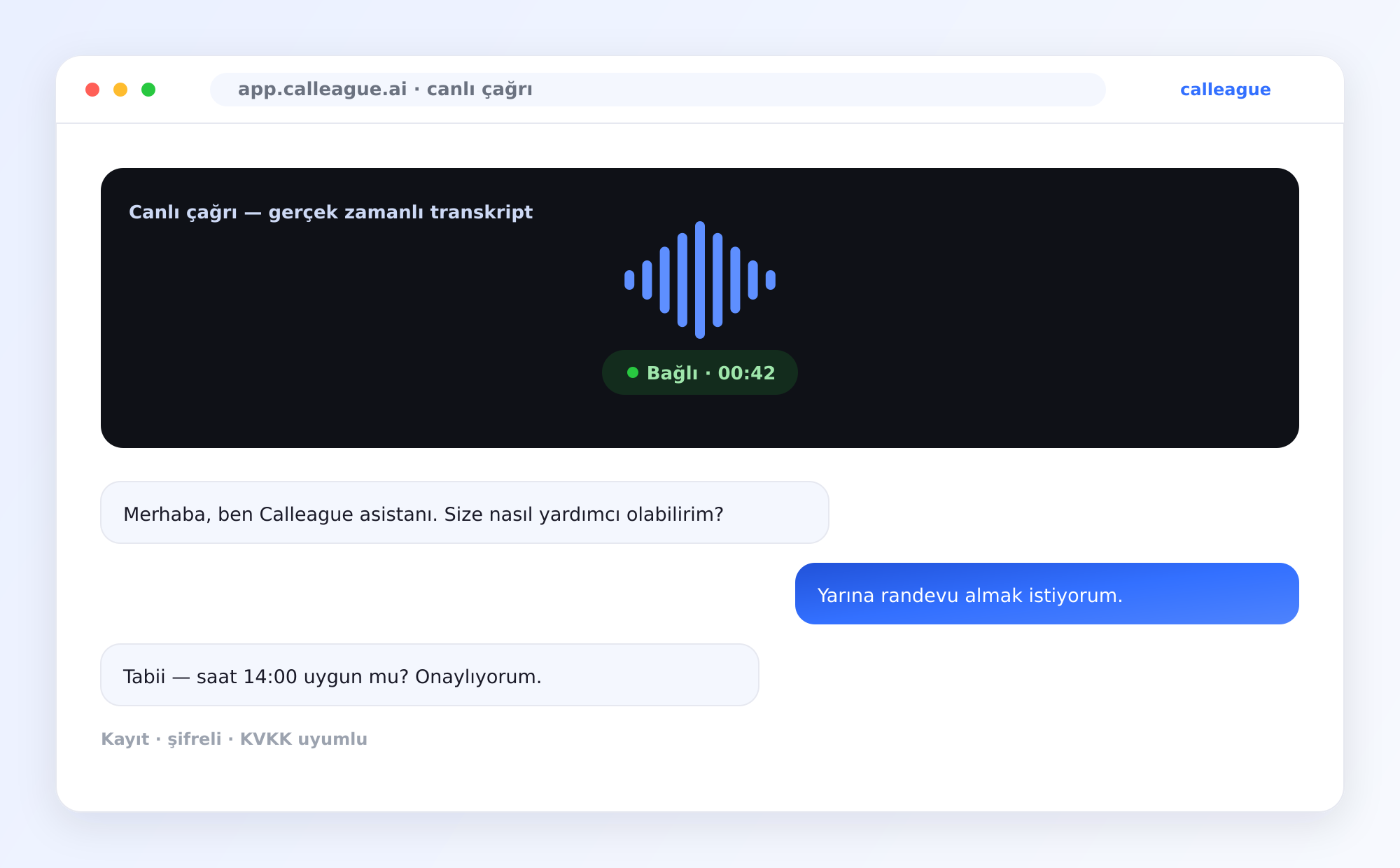
Watch a call as it happens
While a call is going on, the words appear on your screen in real time, almost as they are spoken. You see the caller's words and your assistant's replies, line by line, as the conversation unfolds.
This is handy when you want to:
- Keep an eye on calls that are happening right now.
- Step in if a caller needs you, and take over the conversation.
- See straight away that your assistant is answering the way you intended.
Review past calls any time
When a call ends, its transcript is saved in your call history. You can come back to it whenever you like.
- Open call history in the app at app.calleague.ai.
- Pick the call you want to look at.
- Read the full conversation — every question, every answer.
You will also see what your assistant did during the call, such as booking an appointment or passing the call to a person. So the history is not just words; it is the full story of what happened.
Transcripts are a quick way to check quality. Read back a few calls now and then to see how your assistant is doing — and tweak its instructions if you would like it to answer differently.
A written record, even without audio
Transcripts and recordings are two separate things. You can keep the written transcript of every call even if you have chosen not to keep an audio recording. That is useful when you want a record of what was said, but would rather not store the audio.
Transcripts come in the caller's language
Because your assistant speaks 32 languages, each transcript is written in the language the call was actually spoken in. A call in Turkish gives you a natural Turkish transcript; a call in English gives you an English one. See Languages for more.
Your transcripts are private
A transcript can contain personal details, so it is treated with the same care as a recording:
- It is stored securely, where only you and the people you allow can read it.
- You decide how long transcripts are kept.
- You can ask for a caller's transcripts to be deleted, and Calleague will remove them.
A written transcript is still personal information. Handle it as carefully as you would an audio recording. Calleague follows KVKK (Türkiye) and GDPR, so apply the same care and consent to transcripts as to recordings.
Where to go next
- Call recordings — keep an audio copy alongside the transcript.
- How a call works — see how the conversation is created.
- Your voice assistant — adjust your assistant's instructions based on what you read.
Last Updated